 |
APRIL/MAY 2005 Volume 31.5 Tony Petric, EDITOR |
Executive Committee 2005/06 President's Report Volunteers New Members MUFA Service Award Jean Jones Retirement Coca Cola Housing |
|
|
APRIL/MAY 2005 Volume 31.5 Tony Petric, EDITOR |
Executive Committee 2005/06 President's Report Volunteers New Members MUFA Service Award Jean Jones Retirement Coca Cola Housing |

Here are the members of the Executive Committee of the McMaster University Faculty Association for 2005/06. Their terms of office began on May 12, 2005.
President Vice-President Past President Betty Ann Levy
Psychology
PC 308, Ext. 23019
levy@mcmaster.caIan Hambleton
Mathematics & Statistics
HH 320, Ext. 27302
hamblton@mcmaster.caTrevor Chamberlain
Finance
MGD 304, Ext. 23980
chambert@mcmaster.ca
Members at Large
Ian Bruce
Elec & Comp EngineeringITB A213, Ext. 26984 ibruce@mail.ece.mcmaster.ca Richard Butler
Pathology & Mol MedHSC 1R1, Ext. 22705 butlerr@mcmaster.ca Barbara Carpio
NursingHSC 3N25B, Ext. 22607 carpio@mcmaster.ca Juanita DeBarros
HistoryCNH 613, Ext. 24149 debarr@mcmaster.ca Margaret Denton
Gerontological StudiesKTH 226, Ext. 23923 mdenton@mcmaster.ca Derek Lobb
Obstetrics & GynecologyHSC 3N52E, Ext. 22228 lobbd@mcmaster.ca Barbara McDonald
Mills Memorial LibraryL 212C, Ext. 27936 mcdonb@mcmaster.ca David Shore
PsychologyPC 413, Ext. 23013 dshore@mcmaster.ca Mary Silcox
EnglishCNH 330, Ext. 27314 silcox@mcmaster.ca Mike Veall
EconomicsKTH 435, Ext. 23829 veall@mcmaster.ca President's Report
[delivered at the May 5, 2005 Annual General Meeting]
In reviewing the minutes of our January meeting I was dismayed to discover how long I had talked. Because we have an important presentation today, with a reception to follow, this time I am going to keep my remarks to a minimum. Most of the work that was undertaken by the Association this year is captured by the various committee reports. Hence, I will only highlight a few of our activities since the last general meeting.
Remuneration
Between December and March, much time was spent on remuneration planning and negotiating, leading to the recently endorsed remuneration settlement with the Administration. The details of the agreement are in the Remuneration Committee Report. Because we settled for one year, in a matter of months our incoming Executive will be discussing remuneration again. In the meantime, I am hopeful that we will get a clear indication from the provincial government that it will support, tangibly, the Rae Committee's recommendations for the funding of post-secondary education in Ontario. Whether the political uncertainty at the federal level will affect the province's stance remains to be seen.As I noted earlier, the members of the Joint Committee agreed, as part of the negotiating process, to study the issues surrounding the abolition of mandatory retirement as they affect McMaster. For this purpose a Joint Committee sub-committee will be established. Two members of our Association have been approached to represent MUFA and their names will be presented to the Executive for endorsement at its next meeting.
Likewise, the members of the Joint Committee agreed to establish a sub-committee to review post retirement benefits, including pensions and supplementary pensions. The structure of the sub-committee will be the same, with two members representing the Administration and two members representing MUFA. Two of our members have been asked to represent the Association. They have both agreed and their names will be announced once they have been endorsed by the Executive. Finally on the subject of remunerations, I’m pleased to report that yesterday the Librarians Negotiating Committee reached an agreement in principle with the Administration on a new contract. The agreement is subject to the approval of our librarian members and a ballot will be sent out shortly.
Contractually Limited Appointments
Another item about which I would like to speak briefly is the work of the Joint Committee sub-committee to review contractually limited appointments. As I reported at our January meeting, the Committee's report concerning short-term appointments, presented at our 2004 AGM, was subsequently approved by the Senate and implemented effective 2004/05. The Committee then turned its attention to long-term appointments. The MUFA members on the Committee presented the Committee’s report on long-term CLAs to the MUFA Executive in February. It was unanimously endorsed, and then presented to the Joint Committee in April. The report was endorsed by the Joint Committee as well, and has been forwarded to the Senate for its consideration. The key recommendation of the report is the creation of full-time teaching professorships without tenure as a new category of appointment.The work of this sub-committee was considerable and I would like to acknowledge the work of our representatives, Donald Goellnicht, Marilyn Parsons and Les Robb, who continued on the committee even after he retired last year.
Spousal Hiring
At our January meeting, I also reported that the Report of the Committee to Develop a Supplementary Policy Statement Regarding Spousal Hiring Issues had been endorsed by the MUFA Executive and sent to the Senate for approval. It was approved by Senate in March and by the Board of Governors at its meeting last Thursday.
With Thanks
Finally, I would like to offer my sincere thanks to a number of people: the members of the Executive, members of our various standing committees, members who represented the Faculty Association on a variety of University committees and boards, and members who represented us on a series of ad hoc University committees, including both a “little j sub-committee” and two joint Senate/Faculty Association committees. The efforts of all of the people involved deserve to be acknowledged. I would, however, like to offer special thanks to Mike Veall who, as Chair of our Remuneration Committee, provided brilliant leadership in the remuneration negotiations and secured a contract that was overwhelmingly approved by our membership.I would also like to acknowledge the work and support of Ken Cruikshank, our Past-President, whose counsel and experience was an important ingredient in ensuring the Executive functioned effectively over the
course of the year. Ken also undertook the sometimes difficult responsibility of Chair of our Grievances and Special Enquiries Committee and handled the various questions and concerns that were directed to him with his usual aplomb. Ken has served six consecutive years on the Executive, including terms as Vice-President, President and Past-President, and I think, is looking forward to a well-earned year of research leave beginning July 01.Another person whom I would like to acknowledge is Betty Ann Levy, our incoming President. As Vice-President this year Betty Ann found herself in the thick of remuneration negotiations in her very first year on the Executive. She also served the Association as our OCUFA Director, keeping us informed on views and developments at the provincial level and at other Ontario universities.
On my own behalf, as well as that of other members of the Executive and of the various MUFA and other committees that the MUFA office assisted, I would like to thank Phyllis and Kelly for the tremendous support and valuable advice we all received. Their knowledge and experience is vital to the successful functioning of our Association, and I know that with them in the office, Betty Ann and her Executive will be in very good hands. Finally, I would like to say thank you to all of our members for their support and for permitting me to have what has doubtless been the most interesting year in my time at McMaster.
Trevor Chamberlain

| Gloria Joy Jouppien
Andrea McLellan Jean-Eric Tarride |
Monograph
Acquisitions Librarian
Electronic Resources Librarian Clinical Epidemiology & Biostats |
|
Two Sub-Committees As noted in the President’s Report (see page 2 above), the Joint Committee has struck two sub-committees. One will study the ramifications of abolishing mandatory retirement. Henry Jacek, Betty Ann Levy, and Byron Spencer will represent MUFA. Betty Ann Levy, Wayne Lewchuk, and Bernadette Lynn will represent MUFA on the sub-committee examining post-retirement benefits and pension. |
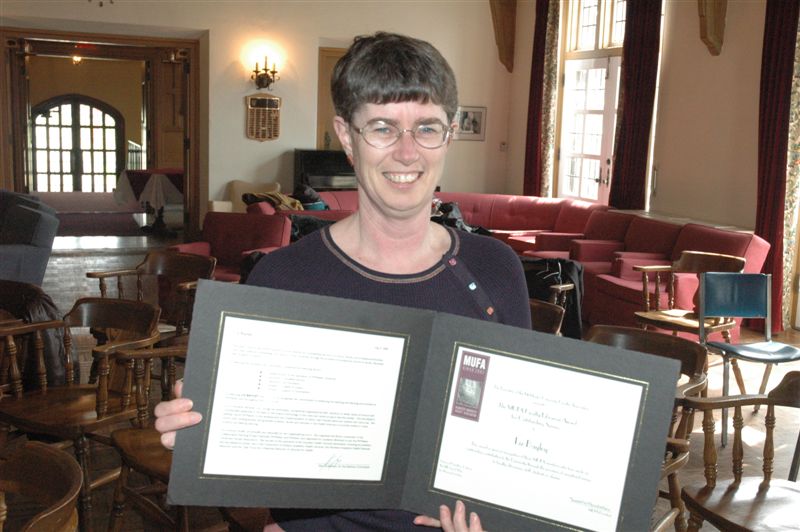
Following MUFA’s Annual General Meeting, a special reception was held in honour of the recipient of the MUFA Faculty/Librarian Award for Outstanding Service. The award was presented to Liz Bayley in recognition of her outstanding contribution to the University through the provision of exceptional service to faculty, librarians, staff, students or alumni. MUFA President, Trevor Chamberlain, thanked the members of the selection committee, which was chaired by past-president Ken Cruikshank, and included staff representative Paul Grunthal and librarian Anne McKeage. Dr. Cruikshank read the following citation on behalf of the selection committee. 
MUFA Service Award
In selecting LIZ BAYLEY, the Committee recognizes her commitment to enhancing the teaching and learning environment at McMaster and throughout North America.
Liz is a dynamic librarian, who brings her enthusiasm, exceptional organizational skills, attention to detail, sense of humour and considerable expertise in the field of information technology to the many and varied projects that she tackles. She has played a leading role at McMaster in the development and implementation of online, user-friendly electronic systems and resources. She works with undergraduate and graduate students, faculty and clinicians in the Health Sciences to promote evidence-based practice and lifelong learning.
Liz is known locally, provincially and nationally for her organizational work. She organized the library component of the Collaborative Nursing Project between McMaster and Mohawk, and negotiated for academic librarians to join the McMaster University Faculty Association. She served on the executive of the Canadian Health Libraries Association, including as president, and has played an active role in the Consortium of Ontario Academic Health Libraries, the Northern Academic Health Sciences Network, and the Task Force for a National Network of Libraries for Health.

Jean Jones
Professor Emeritus
School of Social Work
March 7, 2005
During the forty-five years that I have known her, Jean Jones and I have done a variety of good works together and I have long considered her to be one of my best friends. When I moved to Hamilton in 1959 to help set up the Social Planning and Research Council of Hamilton and District and become its executive director, I met and quickly became good friends with Jean and Frank Jones. Frank had come to McMaster in 1955 to become the first chairman of the new Department of Anthropology and Sociology. Jean was then a homemaker looking after their two children, David and Dilys. As I got to know Jean better I came to appreciate how much she had to offer. She had a fine analytical and critical mind, was exceptionally well read in the field of social welfare and was a keen student of the social sciences in general. She was a bright, confident and articulate person with good judgement and challenging ideas. By the time the Social Planning Council had decided to establish a Volunteer Bureau in 1963, my respect for Jean was such that she was the first person I approached in our search for a Director to head up the new Bureau. She was awarded this post and gave strong leadership through to 1967 when she returned to McGill University to complete the requirement for her MSW degree. The following year Jean returned to the Council as a Planning Associate. In 1968 I was invited by McMaster University to accept the task of establishing a School of Social Work there. My earlier association with Jean had given me first-hand knowledge of her many strengths and it is perhaps not surprising that she was the first person I recruited after accepting the position of Director. Typically, even before her appointment was ratified by the administration, she generously made herself available for consultation with me as I struggled to develop a program of social work education and the details of curriculum.
At the end of June 1975, my term as Director came to an end and Jean was appointed to replace me. During the seven years since her appointment to the faculty she had proved to be unflagging in her devotion to the School. No one gave me stronger support in the development of the School and she was the unanimous choice to succeed me and become the second Director of the School.
Jean’s record of public service at both the community and university levels is, to say the least, impressive. Within the University she not only taught and served the School of Social Work in many other ways but she became a member of both the University Senate and the Board of Governors. She also was President of the Faculty Association and later on was awarded the Honourary Doctor of Laws by McMaster University.
After retirement in 1988 she continued her community activities with typical enthusiasm, energy and commitment. I must say that I found it hard to keep track of the multitude of agencies and community activities she was involved in. I will leave the listing of all this to those involved in such activities. I remember, however, that Jean had a special interest in the field of health and I was always proud of the fact that she was a member of the Economic Council of Canada and President of the Consumers Association of Canada. Finally, I have always supported Second Stage Services and will continue to do so in her memory.
Jean’s resumé will show that she was the recipient of several national honours including: The Centennial medal, 1967; the Canadian Silver Jubilee Medal commemorating the 25th Anniversary of the reign of Her Majesty Queen Elizabeth II, 1977; the Order of Canada (for which, I am proud to say, I was one of the nominators), 1996; and the Queen’s Jubilee Medal, 2002.
Jean certainly left her mark on everything she touched. She was one of my favourite people and a very dear friend. I will miss her deeply.
Harry L. Penny
Professor Emeritus, Social Work
RETIRING
this Year?Electronic Mail Accounts: It is agreed that provision of e-mail computer accounts for retired faculty members is to be treated similarly to the provision of mail boxes or library cards. All retired faculty should have access to an e-mail account on the same terms as active faculty. Like the mail box or library card, the e-mail account is to be used for University or academic business. The account may be accessed from University computers or by modem. In the latter case, if the retired faculty member wishes a fee modem account, this is also available and can be arranged (for example, through the purchase of vouchers at the Bookstore or by provision of a research account number).
Given past experience with illegitimate use of computer accounts by "hackers", it is recognized that for management purposes it might be necessary to require retired faculty to renew the e-mail computer account from time to time, or for CIS to remove accounts that are inactive over a long period of time.
This policy shall be reviewed no later than five years after its implementation.
Re-endorsed by Joint Committee
May 29, 2001Termination Option: During the fall of 1996, the Joint Committee recommended and the President agreed that those faculty who at the time of retirement elect the Pension Plan's Termination Option, should continue to qualify for the normal retirement benefits.
Major Medical & Dental Benefits: Continuation of benefits which were in effect prior to retirement (some exceptions apply), for retiree, spouse and eligible children. Out-of-Province/Out-of-Country-Coverage is reduced to $10,000/ lifetime. It is recommended that you obtain extra travel insurance every time you travel out of Ontario or Canada. You will be receiving a booklet from Human Resources which explains the benefits which are supplied by Sun Life. The booklet is also available on the web (from the McMaster Home Page: click on Working at McMaster; then click on Job Matters; click on Retirement Support Services; click on McMaster Retirees; click on Retiree Benefit Plans and voilà).
Life Insurance: At normal retirement age (65 years) you will be provided with a paid up policy of $5,000. If you wish to convert your insurance to a private insurance plan, you must apply within one month of your retirement date. Please contact Human Resources for more information.
If you take early retirement, you are able to keep your current coverage (Grandfathered Plan) or the basic plan of 175% of salary (maximum salary $100,000) by paying the full premium which is based on age factors, gender and smoking vs non-smoking. At age 65, however, the policy will be reduced to the Paid Up policy of $5,000.
Parking:
1. Faculty and Staff who have retired but have a post-retirement appointment for which they receive remuneration from the University shall pay for parking (effective July 1, 1992).2. Faculty and staff who have retired on or before June 30, 1992 shall continue to receive free parking; in the case of those who are under 65 the free parking shall be provided on West Campus. Any who have already reached 65 and are parking on West Campus should receive a Central Campus sticker immediately.
3. Faculty and staff who retire after June 30, 1992 may obtain a permit which allows (i) free parking on West Campus at all times and (ii) free parking on Central Campus for the period May to August and after 12:30 p.m. on days when classes are held between September and April; alternatively such individuals may purchase, at the Central Campus rate for eight months, a permit for Central Campus.
Approved by Joint Committee
December 3, 1991Notice: to Retirees with Restricted Retiree Parking Permits
(1) HOURLY PARKING
We are pleased to inform you that the automation of the kiosks has given us an opportunity to set up 1, 2 and 3 hour blocks of parking for retirees holding restricted retiree permits that become valid at 12:30 p.m. Retirees who wish to park on central campus prior to 12:30 p.m. may purchase parking for the duration of time prior to 12:30 p.m. only. The above issued permits must be displayed with a restricted retiree permit, which takes effect at 12:30 pm.
(2) CENTRAL CAMPUS PARKING
Eight month central campus parking permits are available for purchase at the Parking Office at the regular permit fee.Retiree permits are for the sole use of the retiree and are not transferrable to family members.
Please contact the Parking & Transit Services office, CUC 102, at 24921 or e-mail: parking@
mcmaster.ca. For up-to-date information and rates, visit their web site at http://parking.mcmaster.ca.
Recreational Facilities: Anyone who retired prior to 1999 will continue to receive free membership at the Ivor Wynne Centre. Those who retired in 1999 may apply for membership at one-half price. All retirees after 1999 are eligible for membership in the Ivor Wynne Centre at a rate that will be prescribed annually and approved by the Board of Governors.
Approved by Joint Committee
June 21, 1999
CAUT Services: Individuals who were eligible for membership in CAUT through MUFA before retirement, are eligible for membership as CAUT retirees. Individual retired members may join CAUT as Retired Associate Members for an annual fee of $30. For this fee they receive a subscription to the CAUT Bulletin, and may join a number of group plans offered for Life Insurance, Personal Accident Insurance, Family Life Insurance, Professional Property Insurance, Group Home Insurance, Travel Insurance, and other financial services. Retired members can also hold office and serve on CAUT committees. For more information, contact the MUFA Office (mufa@mcmaster.ca; Ext. 24682)
About eight years ago, Coca Cola signed an exclusive contract with McMaster University that excluded from campus any alternatives to the products supplied by Coke. It gave Coke exclusive rights for ten years, with the proviso that if a certain quota of sales was not met at this time, the exclusivity would continue for another two years. I do not know what other clauses are present in the contract, because neither students nor faculty are allowed to see it — even though it was signed by our authorities, presumably representing us.
I think our campus community should be able to choose not to consume Coca Cola products without having to leave the campus grounds, and the reason is not merely that I believe in consumer choice.
The following Coca Cola workers, most of them belonging to the negotiating teams of their union (SINALTRAINAL), have been murdered in Colombia and the Coca Cola bottling plants have been implicated in their murders: Avelino Erazo (1990); Jose Manco David, Luis Enrique Arango, Luis Enrique Granado, all in 1994 in the town of Carepa; Jose Herrera Osorio and Isidro Segundo Gil, both in 1996 also in the town of Carepa; Adolfo Munera Lopez in Barranquilla in 1997; and Oscar David Soto in the town of Cordoba during negotiations in 2001.
The case of Isidro Gil merits special attention because it is well documented:
In 1995, Isidro Gil was elected to the executive board of SINALTRAINAL (the local union that represented most Coca Cola workers). The following month, the company hired paramilitaries, who began threatening union members. Shortly thereafter, the bottling plant hired Ariosto Mosquera to manage the plant. He began having frequent meetings with the paramilitaries and boasted he would rid the company of the union. In September of 1996, SINALTRAINAL sent a letter to the bottling plant, with a copy to Coca Cola Colombia (headquarters), accusing Mosquera of working with the paramilitaries to destroy the union. On December 5, 1996, two paramilitaries entered the plant where Isidro Gil worked and shot him. Witnesses identified the murderers as paramilitaries that had previously been in the plant conferring with Mosquera. That evening, the same paramilitaries set fire to the local union hall of SINALTRAINAL. Two days later, paramilitaries arrived at the plant and assembled all the employees, threatening them with the same fate as Gil if they did not resign. All the employees then went into the manager's office and signed resignation papers, which had already been prepared for them. As a consequence of these events, SINALTRAINAL disappeared from the plant at Carepa and wages dropped from $380/month to $130/month.
At the request of his Colombian constituents, Councilman Hiram Monserrate of the 21st District of New York City went with an official delegation on a visit to Colombia to investigate the allegations against Coca Cola. (1) The delegation heard the testimony regarding Isidro Gil. (2) The delegation found that Coca Cola in Bucaramanga had falsely accused five of their SINALTRAINAL unionists, leading to six months in jail for three of them, only to have all the charges dismissed as having no merit when the matter finally went to trial. There was no compensation by Coca Cola. (3)Witnesses in Barrancabermeja informed the delegation that paramilitaries freely entered the local bottling plant, and that the practice continued as of 2003 (when the delegation was there). Incidentally, I met the local executive of SINALTRAINAL when I was in Barrancabermeja last summer. They had all been receiving death threats, and one of them, William Mendoza, had his 4 year old daughter nearly kidnapped and later threatened with death if he did not get out of town. (4) Witnesses asserted that the local Panamco (Coca Cola) bottling plant paid paramilitaries every 28th of the month. This allegation was confirmed by Colombia's Defense Ministry and by statements of the paramilitaries themselves to NPR reporter Stan Dudley. (5) Paramilitaries in Barranquilla threatened local Coca Cola unionized workers with murder and stated that management had asked them to do so.
Upon his return, Monserrate met with Coca Cola executives in the USA and asked them to conduct an independent investigation of the hundreds of human rights violation claims against them in Colombia. The company refused. Since then Coca Cola paid a company called Cal Safety Compliance Corp to investigate these concerns and Cal Corp gave Coca Cola a clean bill of health. However, Cal Corp is notorious for whitewashing corporation abuses.
Coca Cola also claims it has no control over the labour practices of its bottling plants in Colombia, yet Coca Cola owns more than 39% of the share value of these bottling plants and controls all other matters of interest to the head office. Coke claims that the Colombian authorities have found nothing wrong with the operations of their bottling plants. But when I was there and met with the Ministry of Labour’s second in command, she told me that they have very long lists of complaints and they cannot get to all of them if they are to do a serious job. [This person who spoke to me was the former lawyer for Nestle, which is another company that has an abysmal human rights record in Colombia.] So far none of the paramilitary trade union murderers have been brought to trial, let alone prosecuted.
The behaviour of Coca Cola in Colombia is not new. In the 1970s and 80s, three general secretaries of the trade union representing Coca Cola workers in Guatemala were murdered and five of their workers killed. At least four other of their fellow trade unionists were "disappeared". A worldwide protest against Coca Cola succeeded in stopping these practices.
Many of us on campus feel that Coca Cola should not be permitted to get away with murder in Colombia, or anywhere else. As consumers, an effective way that we can show our concern to the company is not to consume their products and to let them know why. With this kind of consumer pressure, perhaps Coca Cola will find it profitable not to conduct itself the way it does in Colombia at the present time.
For all the above reasons, I urge my faculty colleagues to endorse the following call: that McMaster not renew the exclusive contract with Coca Cola when it comes up for renewal two years from now, thus giving the McMaster community the choice to consume on campus products made by other manufacturers.
George Sorger
Professor Emeritus, Biology
Unfortunately we will not be able to provide the Salary Statistics for 2004/05 at this time. We will put them on our website when the information arrives from Human Resources and print them in the September Newsletter.Apologies for the inconvenience
For Rent 34 Harold Street (near Whitney Avenue and Lower Horning). Brick bungalow, very clean in a charming, quiet, family neighbourhood. Walk or bus to McMaster. Three main floor bedrooms, large eat-in kitchen, large living room, two bathrooms, and a fully finished basement with laundry room. Central air. Each bedroom is wired for high-speed internet and phone jack. Two-car driveway and street parking. Close to all amenities and schools with bike trail nearby. Please no smoking or pets. $1400/month plus utilities. Available immediately. For more information call Nada at 905-528-2382.
June 6, 2005
pdk